EPAM Systems, Inc.
EPAM
Current Price
$139.16
Overall Fundamental Score
Based on 15 criteria · strong fundamentals
Data updated
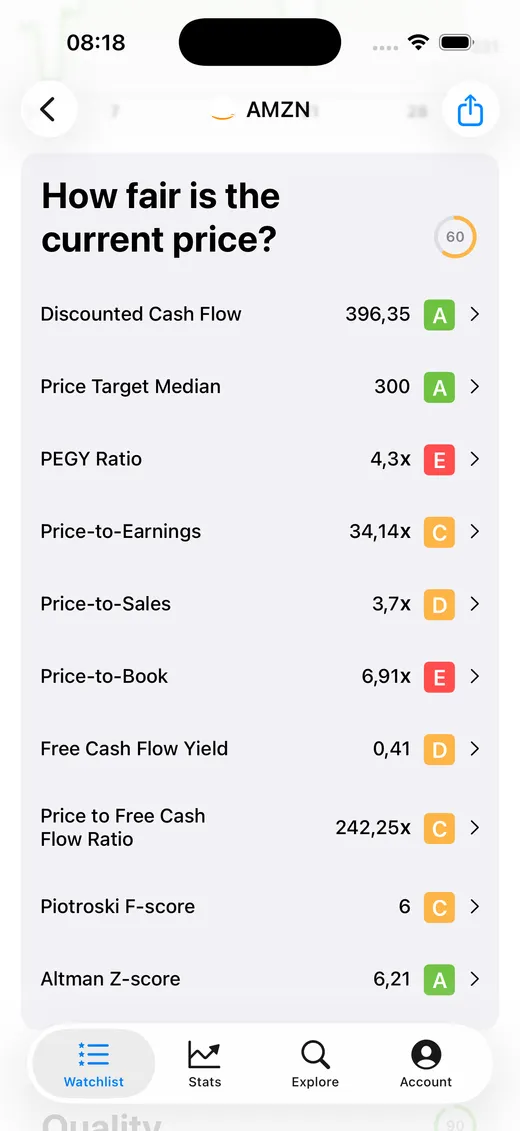
How fair is the current price?
Estimates the intrinsic value of a stock based on projected future cash flows, discounted to present value.
Learn more
What is Discounted Cash Flow?
Discounted Cash Flow analysis estimates what a company is worth today based on how much cash it’s expected to generate in the future. The core idea: a dollar earned next year is worth less than a dollar today, so future cash flows are “discounted” back to present value.
If the DCF value is higher than the current stock price, the stock may be undervalued. If it’s lower, you might be overpaying.
Why it matters for investors
DCF is one of the few valuation methods that tries to calculate an absolute fair value — not a relative comparison to other stocks. Warren Buffett famously uses DCF-style thinking when evaluating investments.
It answers the question every investor should ask: “Based on this company’s expected earnings, what should the stock actually be worth?”
How Stock Analyzer scores it
Stock Analyzer compares the DCF value to the current stock price as a percentage:
| Score | DCF vs. Price | What it means |
|---|---|---|
| A | DCF is 110%+ of price | Stock appears undervalued |
| B | 100% – 110% | Close to fair value |
| C | 95% – 100% | Slightly overvalued |
| D | 85% – 95% | Overvalued |
| E | Below 85% | Significantly overvalued |
What to watch out for
DCF models are only as good as their assumptions. Small changes in growth rate or discount rate can dramatically change the result. Use DCF alongside other metrics — it’s most useful when it agrees with other valuation signals.
The median analyst price target compared to the current stock price, expressed as a percentage.
Learn more
What is the Price Target Median?
The price target median is the middle value of all analyst price targets for a stock. Analysts at investment banks and research firms publish target prices — their estimate of where a stock should trade within the next 12 months. The median gives you the consensus view without being skewed by extreme outliers.
Stock Analyzer compares this median target to the current stock price and expresses it as a percentage. If the median target is $110 and the stock trades at $100, the result is 110% — suggesting analysts expect 10% upside.
Why it matters for investors
Price targets reflect professional analyst expectations for a stock’s near-term direction. While no analyst is consistently right, the consensus view provides useful context alongside fundamental metrics. A stock that looks undervalued by DCF and has analyst targets well above the current price strengthens the case for undervaluation.
However, analyst targets tend to be backward-looking and slow to adjust. They often cluster around recent prices and can lag behind major business changes. Use them as one signal among many, not as a standalone indicator.
How Stock Analyzer scores it
| Score | Target vs. Price | What it means |
|---|---|---|
| A | 110%+ | Analysts see significant upside |
| B | 100% – 110% | Modest upside expected |
| C | 95% – 100% | Roughly fair value |
| D | 90% – 95% | Slight downside expected |
| E | Below 90% | Analysts see meaningful downside |
What to watch out for
Analyst coverage varies widely. Large-cap stocks like Apple might have 40+ analysts, making the median robust. Small-cap stocks might have only 2-3 analysts, making the median less reliable. Also, analysts can be slow to downgrade stocks, so targets often remain optimistic even as fundamentals deteriorate.
Compares the stock price to its earnings per share. A lower P/E may indicate undervaluation relative to earnings.
Learn more
What is the P/E Ratio?
The Price-to-Earnings ratio compares a company’s current stock price to its earnings per share (EPS). It tells you how much investors are willing to pay for each dollar of earnings.
A P/E of 15 means investors pay $15 for every $1 the company earns annually. Think of it as how many years of current earnings it would take to pay back your investment — assuming earnings stay constant.
Why it matters for investors
The P/E ratio is one of the most widely used valuation metrics because it quickly shows whether a stock is cheap or expensive relative to its earnings.
A low P/E can signal an undervalued stock — or a company with declining earnings. A high P/E can signal an overvalued stock — or a company with strong growth expectations. Context matters. A tech company with a P/E of 30 might be reasonably priced if it’s growing revenue at 40% per year, while a utility company at the same P/E could be wildly overpriced.
How Stock Analyzer scores it
| Score | P/E Range | What it means |
|---|---|---|
| A | 10 – 17 | Fair value range for most companies |
| B | 0 – 10 or 17 – 25 | Potentially undervalued or moderately priced |
| C | 25+ | High expectations priced in |
| E | Below 0 | Negative earnings (company is losing money) |
What to watch out for
A P/E ratio alone never tells the full story. Always consider it alongside growth metrics (like the PEG ratio), quality indicators (like ROIC), and the company’s sector average. A “good” P/E for a bank is different from a “good” P/E for a software company.
Compares the stock price to its revenue per share. Useful for evaluating companies that aren't yet profitable.
Learn more
What is the Price-to-Sales Ratio?
The Price-to-Sales ratio compares a company’s market capitalization to its total revenue. It tells you how much investors are paying for each dollar of sales. Unlike the P/E ratio, P/S works even for companies that aren’t yet profitable — because every company generating revenue has a P/S ratio, regardless of whether it earns a profit.
A P/S of 2 means investors pay $2 for every $1 of annual revenue. Lower values generally indicate better value, though the “right” P/S varies significantly by industry.
Why it matters for investors
P/S is especially useful for evaluating high-growth companies that reinvest all their revenue into growth and don’t yet show earnings. It’s also harder for management to manipulate than earnings-based metrics, since revenue is a more straightforward number than net income.
Software companies often trade at P/S ratios of 10-20x because of their high margins and recurring revenue. Retailers might trade at 0.5-1x because of thin margins. Always compare P/S within the same industry.
How Stock Analyzer scores it
| Score | P/S Range | What it means |
|---|---|---|
| A | Below 1 | Paying less than $1 per $1 of revenue |
| B | 1 – 2 | Reasonably valued relative to sales |
| C | 2 – 3 | Moderate premium to revenue |
| D | 3 – 4 | Elevated valuation |
| E | Above 4 | High premium — needs strong growth to justify |
What to watch out for
A low P/S ratio isn’t always a bargain. A company with a P/S of 0.3 might have razor-thin margins and declining revenue — meaning it’s cheap for a reason. Always pair P/S with profitability metrics like gross margin and ROIC to understand whether the company can actually convert revenue into profits.
Compares the stock price to its book value per share. A P/B below 1 may indicate the stock is trading below its net asset value.
Learn more
What is the Price-to-Book Ratio?
The Price-to-Book (P/B) ratio compares a company’s market capitalization to its book value (total assets minus total liabilities). Book value represents what shareholders would theoretically receive if the company liquidated all its assets and paid off all debts.
A P/B of 1.0 means the stock trades at exactly its book value. A P/B below 1.0 suggests the market values the company at less than its accounting value — potentially undervalued. A P/B above 1.0 means investors are paying a premium over book value, often because they expect future earnings growth or the company has valuable intangible assets not reflected on the balance sheet.
Why it matters for investors
The P/B ratio is particularly useful for asset-heavy companies like banks, insurance firms, and industrial manufacturers where book value is a meaningful measure of underlying value. For these companies, a P/B below 1.0 can signal a genuine bargain — you’re buying assets for less than they’re worth on paper.
However, P/B ratios are less meaningful for asset-light businesses like software companies or service firms. These companies derive most of their value from intangible assets (brands, intellectual property, customer relationships) that aren’t fully captured in book value. A software company with a P/B of 10 might still be reasonably priced if its earnings and cash flow justify the premium.
How Stock Analyzer scores it
| Score | P/B Range | What it means |
|---|---|---|
| A | Below 1 | Trading below book value — potentially undervalued |
| B | 1 – 2 | Fair value range — reasonable premium to book |
| C | 2 – 3 | Moderate premium — growth expectations priced in |
| D | 3 – 4 | High premium — requires strong growth to justify |
| E | 4+ | Very expensive — significant premium over book value |
What to watch out for
Book value can be misleading if a company’s assets are overstated or its liabilities are understated. Check for large amounts of goodwill from acquisitions — this inflates book value but may not represent real economic value. Also, book value uses historical cost accounting, so assets like real estate or inventory may be worth far more (or less) than their book value suggests.
For companies with significant intangible assets or intellectual property, book value understates true worth. Always compare P/B ratios within the same industry, and consider other metrics like price-to-earnings or free cash flow yield to get a complete picture of valuation.
Measures how much free cash flow a company generates relative to its market value. Higher yields suggest better value.
Learn more
What is Free Cash Flow Yield?
Free cash flow yield measures how much cash a company generates relative to its market capitalization, expressed as a percentage. Free cash flow is the cash left over after a company pays for operating expenses and capital expenditures — the money available to pay dividends, buy back stock, reduce debt, or invest in growth.
A FCF yield of 7% means the company generates $7 in free cash flow for every $100 of market value. Think of it as the “dividend” the company could pay if it distributed all its free cash flow to shareholders. Unlike earnings, cash flow is harder to manipulate with accounting tricks, making FCF yield a more reliable measure of a company’s true profitability.
Why it matters for investors
Free cash flow yield helps you identify companies that generate substantial cash relative to their stock price. High FCF yields (7%+) suggest the stock may be undervalued or the company is exceptionally efficient at converting revenue into cash. This cash can fund dividend increases, share buybacks, or strategic acquisitions — all of which benefit shareholders.
However, FCF yield can be misleading for companies in heavy growth mode that are reinvesting all their cash into expansion. A tech startup with a 2% FCF yield might be a better investment than a mature company with 10% FCF yield if the startup is growing revenue at 50% per year. Always consider FCF yield in context of the company’s growth stage and reinvestment needs.
How Stock Analyzer scores it
| Score | FCF Yield Range | What it means |
|---|---|---|
| A | 7%+ | Excellent cash generation — strong value signal |
| B | 4% – 7% | Good cash generation — healthy cash flow |
| C | 1% – 4% | Moderate cash generation — acceptable but not exceptional |
| D | 0% – 1% | Low cash generation — minimal free cash flow |
| E | Below 0% | Negative cash flow — company is burning cash |
What to watch out for
Free cash flow can be volatile from year to year due to one-time items, working capital changes, or timing of capital expenditures. A company might show a high FCF yield one year because it delayed equipment purchases, then drop the next year when those purchases are made. Look at multi-year averages rather than single-year snapshots.
Also, beware of companies with high FCF yields that are actually in decline. A company cutting back on growth investments will show higher FCF yield in the short term, but this may signal shrinking opportunities rather than efficient operations. Compare FCF yield to revenue growth trends to distinguish between efficient cash generators and companies in managed decline.
Compares the stock price to its free cash flow per share. Similar to P/E but uses cash flow instead of earnings.
Learn more
What is Price to Free Cash Flow?
Price to Free Cash Flow compares a company’s market price to the cash it actually generates after paying for operations and capital expenditures. Free cash flow represents the money available to pay dividends, buy back shares, reduce debt, or invest in growth — it’s the cash that truly belongs to shareholders.
A P/FCF of 15 means investors pay $15 for every $1 of annual free cash flow the company produces. Think of it as the P/E ratio’s more honest cousin — because while earnings can be inflated by accounting choices, cash flow is much harder to manipulate.
Why it matters for investors
Earnings can be distorted by depreciation methods, one-time charges, stock-based compensation, and other accounting decisions. Free cash flow cuts through that noise and shows whether a company is actually generating cash. A company can report strong earnings while burning cash — and vice versa.
P/FCF is particularly valuable for capital-intensive businesses (manufacturing, telecom, utilities) where the gap between earnings and cash flow can be significant due to heavy depreciation and ongoing capital expenditure requirements.
How Stock Analyzer scores it
| Score | P/FCF Range | What it means |
|---|---|---|
| E | Below 0 | Negative free cash flow — burning cash |
| B | 0 – 10 | Strong cash generation relative to price |
| A | 10 – 17 | Healthy sweet spot |
| B | 17 – 25 | Moderately valued |
| C | Above 25 | Premium valuation relative to cash flow |
What to watch out for
Free cash flow can be lumpy. A company might have low FCF one year because it invested heavily in a new factory, then high FCF the following years as that investment pays off. Look at multi-year trends rather than a single year. Also, some high-growth companies intentionally sacrifice current FCF for future growth — a negative P/FCF isn’t always bad if the investment is sound.
A 0-9 score measuring financial strength based on profitability, leverage, and operating efficiency. Higher is better.
Learn more
What is the Piotroski F-Score?
Developed by accounting professor Joseph Piotroski in 2000, the F-Score is a 0-9 rating system that measures a company’s financial strength. Each point is earned by passing a specific test in three areas:
Profitability (4 points): Positive net income, positive operating cash flow, rising ROA, and cash flow exceeding net income.
Leverage & liquidity (3 points): Decreasing long-term debt ratio, increasing current ratio, and no new share dilution.
Operating efficiency (2 points): Improving gross margins and improving asset turnover.
Why it matters for investors
The F-Score was originally designed to separate strong companies from weak ones among low-price-to-book stocks. But it works well as a general quality filter too.
A high F-Score means the company is improving across multiple dimensions simultaneously. That’s hard to fake and difficult to sustain without genuine business strength.
How Stock Analyzer scores it
| Score | F-Score | What it means |
|---|---|---|
| A | 8 – 9 | Strong financial health |
| C | 3 – 7 | Average, mixed signals |
| E | 0 – 2 | Weak fundamentals |
What to watch out for
The F-Score is backward-looking — it tells you about the last reporting period, not the future. A company in rapid decline might still have a decent F-Score from its recent past. Combine it with forward-looking metrics like analyst price targets and DCF analysis.
Predicts the probability of bankruptcy within two years. Scores above 3 indicate financial safety.
Learn more
What is the Altman Z-Score?
The Altman Z-Score is a financial model developed by Edward Altman in 1968 that predicts the likelihood of a company going bankrupt within two years. It combines five financial ratios into a single score: working capital to total assets, retained earnings to total assets, earnings before interest and taxes (EBIT) to total assets, market value of equity to total liabilities, and sales to total assets.
The model assigns weights to each ratio based on historical bankruptcy data. A Z-Score above 3.0 indicates low bankruptcy risk, while a score below 1.8 signals high distress risk. Scores between 1.8 and 3.0 fall in a “gray zone” where the company may be financially stressed but not necessarily headed for bankruptcy.
Why it matters for investors
The Altman Z-Score helps you identify companies that may be heading toward financial distress before it becomes obvious in other metrics. A low Z-Score doesn’t guarantee bankruptcy, but it flags companies with deteriorating financial health that warrant extra scrutiny. This is especially valuable for value investors who might otherwise be tempted by seemingly cheap stocks.
However, the Z-Score was originally designed for manufacturing companies and may be less accurate for service firms, tech companies, or businesses with different capital structures. It also relies on market value, which can be volatile and may not reflect true financial health during market panics or bubbles.
How Stock Analyzer scores it
| Score | Z-Score Range | What it means |
|---|---|---|
| E | Below 1.8 | High bankruptcy risk — financial distress likely |
| C | 1.8 – 3.0 | Gray zone — moderate risk, requires investigation |
| A | 3.0+ | Low bankruptcy risk — financially healthy |
What to watch out for
The Altman Z-Score is a statistical model based on historical data, not a crystal ball. Companies can recover from low Z-Scores through restructuring, asset sales, or improved operations. Conversely, companies with high Z-Scores can still fail due to fraud, sudden market shifts, or management mistakes.
Always use the Z-Score alongside other financial health indicators like debt-to-equity ratios, interest coverage, and cash flow trends. For non-manufacturing companies, consider industry-specific financial health metrics that may be more appropriate than the standard Z-Score model.
Quality, Dividend & Volatility
6 more scores waiting for you
ROIC, ROE, Dividend Yield, Beta, and more — each with detailed explanations. Free in the app.
See the Full Report — Free Download19
Fundamental criteria scored A-E
4
Categories: Value, Quality, Dividend, Volatility
Real-time
Live prices & latest financial data
Don't invest in EPAM without the full picture
You've seen 9 of 15 criteria. The remaining 6 scores could change your decision. Get them all — free.
Download Free on the App Store